Monday, 6 April 2020

C19, who'd have know?

As we are all currently confined to home territories outings have had to be postponed, cancelled, or put into abeyance. Our annual visit to Nan Ron, although still some weeks away, may actually be caught up in the tail end of the current situation - and we may not be able to visit this year.
I have had a look though all of our visits over the last years to find out when the latest visit in the year was made, and Stormies were still being caught. The answer was the 14th Sept, so I/we must live in hope.
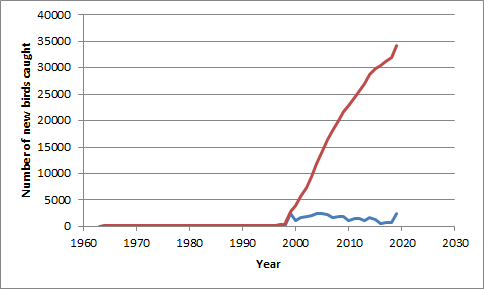
While looking back through these years I started to play with some of the figures. Below is a graph which shows the annual totals, in blue, and the cumulative total in red. This relates to new birds caught only.
Since 1999 when we actually started to target Storm Petrels we have rung, on average, c1600 birds per annum. The best years to date have been 1999, 2004 and 2005 when over 2400 new birds were ringed. Last year, 2019, we rang 2358; but we should bear in mind that we now not only ring but collect full biometrics on most birds and, where informative, we photograph as well.

To date we have rung 34,246 birds.

Friday, 24 January 2020

Breeding Storm Petrel survey

I've just received from Danni (Thompson) at JNCC a map showing the survey locations looking for breeding Storm Petrels on Nan Ron. This was undertaken in 1995. It is our intention under Danni's guidance to resurvey the complete island this year for comparison. We're going to be busy......

Sunday, 19 January 2020

?last of 2019 first of 2020?

2592002
03.08.2017 // age 6 // Tiumpan Head, Western Isles
31.07.2019 // age 4 // ENR
727days 110km 

Saturday, 18 January 2020

GPS track on Italian Storm Petrel

Posted by Feberico De Pascalis via his Twitter account (@fdepa1) the first GPS track of an italian storm petrel - a 28g bird travelling up to 200km from its breeding colony foraging in a single day! Wonder if it does this every day?

Friday, 10 January 2020

and more.

First two British controls, then Norwegians
2739230
12.7.2019 Shillay Island, Western Isles
29.7.2019 ENR = 17 days 190km

2762170
17.4.2016 Fair Isle Bird Observatory
29.7.2019 ENR = 13 days 190km

2E07409 
26.08.2017  Herdlevaer, Oygarden, Hordeland, Norway
31.07.2019 ENR = 704 days, 561km

ED00284
09.08.2014 Hamnaholmen, Romsdal, Norway
01.08.2019 ENR = 1818 days, 675km

ED03463
20.07.2019 Lindesnes Fyr, Vest-Agder, Norway
02.08.2019 ENR = 13 days, 670km

Good news x2 (or is that three?)

1. We heard, just before Christmas, that one of our grant applications had been successful. Our request to the Seabird Group had been approved, so we have some money in the pot to enable us to molecularly sex some of the birds we catch this year as part of our study on trying to produce a definitive method for pheno-morphological sexing of Storm Petrel (i.e. can you do it by just looking at the bird in the hand together with a few measurements).
2 and 3. Have just had news back of the Portuguese birds caught last year.
Both were initially caught and ringed at the same place - Ponta de Almadena, Portugal - one on the 18th June (N7599) and the other (N7624) on 20th. N7624 was recaptured on Nan Ron on the 30th July and N7599 the next night. So both had covered the 2411km in about 40 days.

Sunday, 20 October 2019

Grant submissions

Last year we thought we had fully mastered the in-hand sexing of Storm Petrels. However, fresh eyes and new opinion this year took us virtually back to square one. In conclusion we consider those at extremes of morphology are sexable, while the majority sit between these extremes. In order to add full value to the birds we are catching we need to reduce the number of birds that sit in the middle. Consulting literature and those who have been handling Stormies for years we felt there was still insufficient guidance in this area. To this end we have prepared and submitted two grants, one to the Seabird Group and the other to the BOU.
In essence we are requesting funding to molecularly sex 200 Storm Petrels - this to be our gold standard. Then while birds are in the hand we shall take morphological measurements and a series of photographs which will then be analysed and interpreted (blind) to assign sex to an individual. The resultant sexing of individuals by these methods (alone or in combination) will then be compared to the molecular result in the hope of producing more detailed guidelines for sexing Storm Petrels.